What Is a Merchandise Bag? Retail Packaging Terms Decoded
If you have ever ordered retail packaging, you know the labels can run together. Merchandise bag, shopping bag, gift bag, produce bag: they all hold a purchase, so what is the actual difference? After more than 32 years in retail and over 20 years here at Store Supply Warehouse, I can tell you the terms matter more than most owners expect. Ordering the wrong style means paying for handles you don’t need or reaching for a bag that is too flimsy for the item.
This guide breaks down these terms so you can stock the right bag for the right job.
What Is a Merchandise Bag in Retail?
A merchandise bag is a basic, no-handle bag used to send a customer's purchase home. It is the everyday workhorse at the counter. You slide the item in, fold the top over if you like, and hand it to a customer.
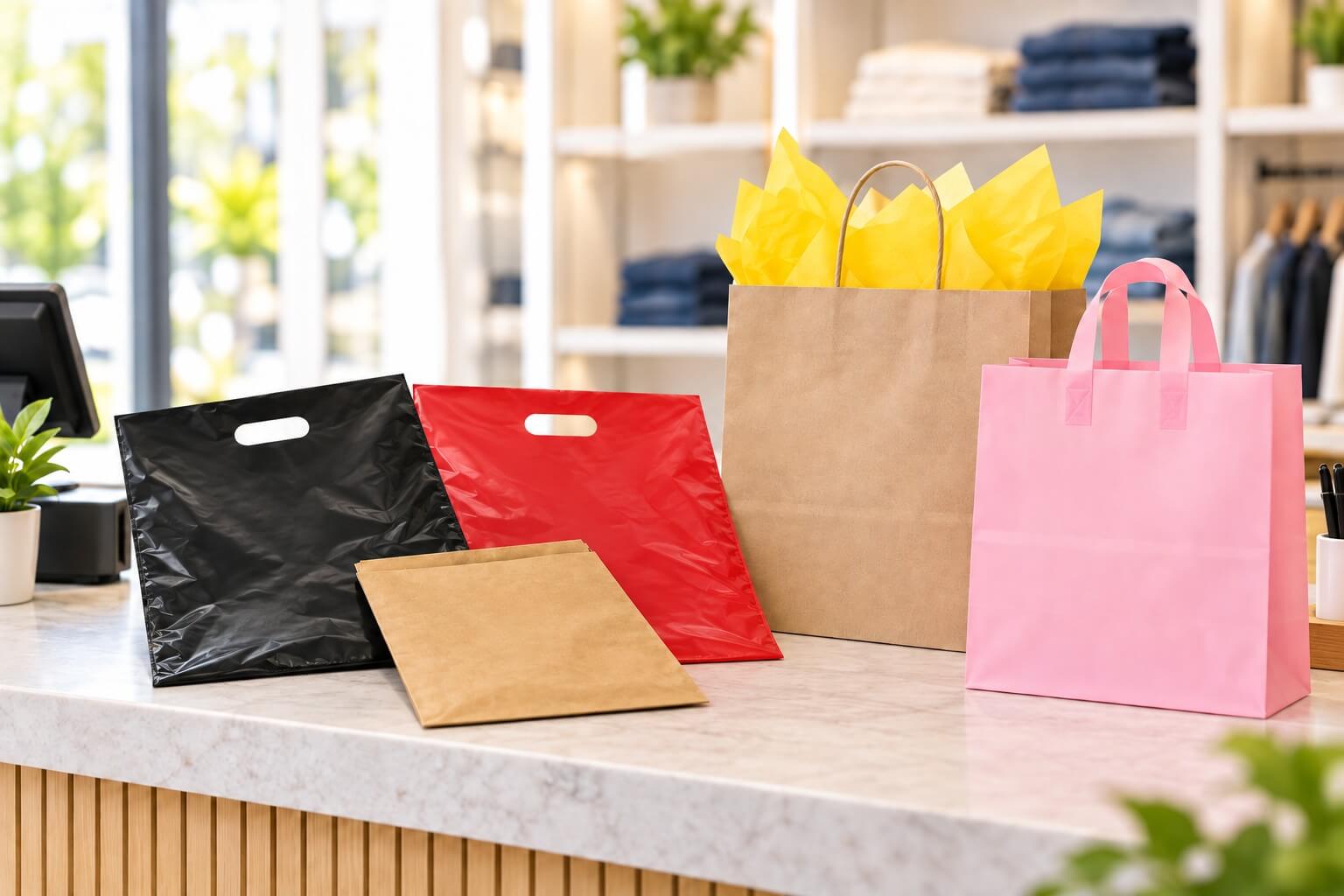
Merchandise bags come in two common materials. Plastic versions have a flat, open-top design and often a die-cut or patch handle opening rather than tied handles. Paper versions, like our small black paper merchandise bags, work well for smaller items such as candies or jewelry.
The point of a merchandise bag is speed and value. It is meant to be functional and affordable, ordered by the case, and used all day long. When retailers ask me for a starting point on packaging, this is almost always the first bag I point them to.
Low Density vs. High Density Plastic Merchandise Bags
Plastic Merchandise bags come in two weights, and the names can be somewhat confusing. Here is the short version.
- Low density bags have a glossy finish and are slightly thicker than high density bags. They feel more substantial in the hand, which is nice for apparel and heavier goods.
- High density bags are thinner and have more of a crinkly feel. They are economical and hold their shape well for everyday items.
Neither is necessarily better across the board. A gift shop selling breakable items may want the heavier low density feel, while a high-volume store moving lighter goods may lean on high density to control cost. You can compare both in our Plastic Merchandise Bags selection.
How Does a Merchandise Bag Differ From a Shopping Bag?
This is the question I hear quite often, and the answer comes down to handles and presentation.
A shopping bag has handles, either twisted paper, ribbon, or a die-cut grip, and it usually stands up on its own. It is built for carrying as well as for looks. A merchandise bag has no tied handles and lies flat until you fill it. It is built for a quick hand-off at the register.
Here is a simple comparison.
|
Feature |
Merchandise Bag |
Shopping Bag |
|
Handles |
None (or die-cut opening) |
Twisted paper, ribbon, or grip handles |
|
Stands upright |
No, lies flat |
Yes, usually |
|
Main use |
Everyday purchases, fast hand-off |
Larger orders, carrying, presentation |
|
Cost per bag |
Lower |
Higher |
In my years helping independent retailers, the mistake I see the most is defaulting to a shopping bag for every sale. A customer buying one small item does not need a handled bag, and you end up spending more on packaging than the situation calls for. A mix of both is smarter for your budget.
Shopping bags earn their keep when the order is big, the item is a gift, or you want your branding to walk out the door. Our kraft paper shopping bags are a durable, spacious option when you need that combination of looks and durability.
What Sizes Do Merchandise Bags Come In?
Merchandise bags are typically sold in small, medium, and large. Rather than chase exact numbers, match the bag to what you actually sell.
- Small: a good choice for smaller items like candies or jewelry.
- Medium: a middle ground for mixed goods and everyday apparel pieces.
- Large: a great choice for multiple pieces of apparel and light jackets, and for larger handbags and heavier coats.
Exact dimensions vary by style and material, so check the individual product page for the measurements before you order. A good tip is stocking two sizes covers most stores better than one. When a bag is too big, items slide around; when it is too small, you force the sale into the wrong package and it looks sloppy at the counter.
Choosing the Right Bag for Your Store
Put it all together by asking yourself a few quick questions:
- What do you sell most? Small goods lean toward small merchandise bags; bulky apparel leans large.
- Do customers need to carry it far? If yes, a handled shopping bag is worth the added cost.
- Is presentation part of the sale? Gift-focused and seasonal stores benefit from a decorative option.
- How high is your volume? High-traffic stores often keep plain merchandise bags as the default and reserve shopping bags for bigger orders.
Most owners land on a simple two-bag system: a plain merchandise bag for everyday sales and a handled shopping bag for larger or gift purchases. You can browse the full range across our Retail Shopping Bags category to build a pairing that works for your store.
Once you the terms, ordering gets faster and cheaper. You stop buying bags you don’t use, you stop stuffing large items into small bags, and your checkout runs a little smoother every single day.
Written by Kris Boettigheimer
Purchasing Assistant
Kris brings over 32 years of retail industry experience and more than 20 years at Store Supply Warehouse to every article he writes for storesupply.com. Since joining SSW in 2005, Kris has worked across multiple departments , including six years in Sales/Customer Service, where he helped independent retailers and small business owners find the right store fixtures, retail displays, and merchandising supplies to improve their store layouts and drive sales. For the past 15+ years in SSW's Purchasing Department, he has collaborated with suppliers, tracked market trends, and sourced products across all three Store Supply divisions. Today, Kris channels that hands-on experience into content that helps retailers enhance store presentation, discover new display solutions, and make smarter product decisions.