
8.5x11 or 5x7 Sign Holder: Sizing Signs to Your Message
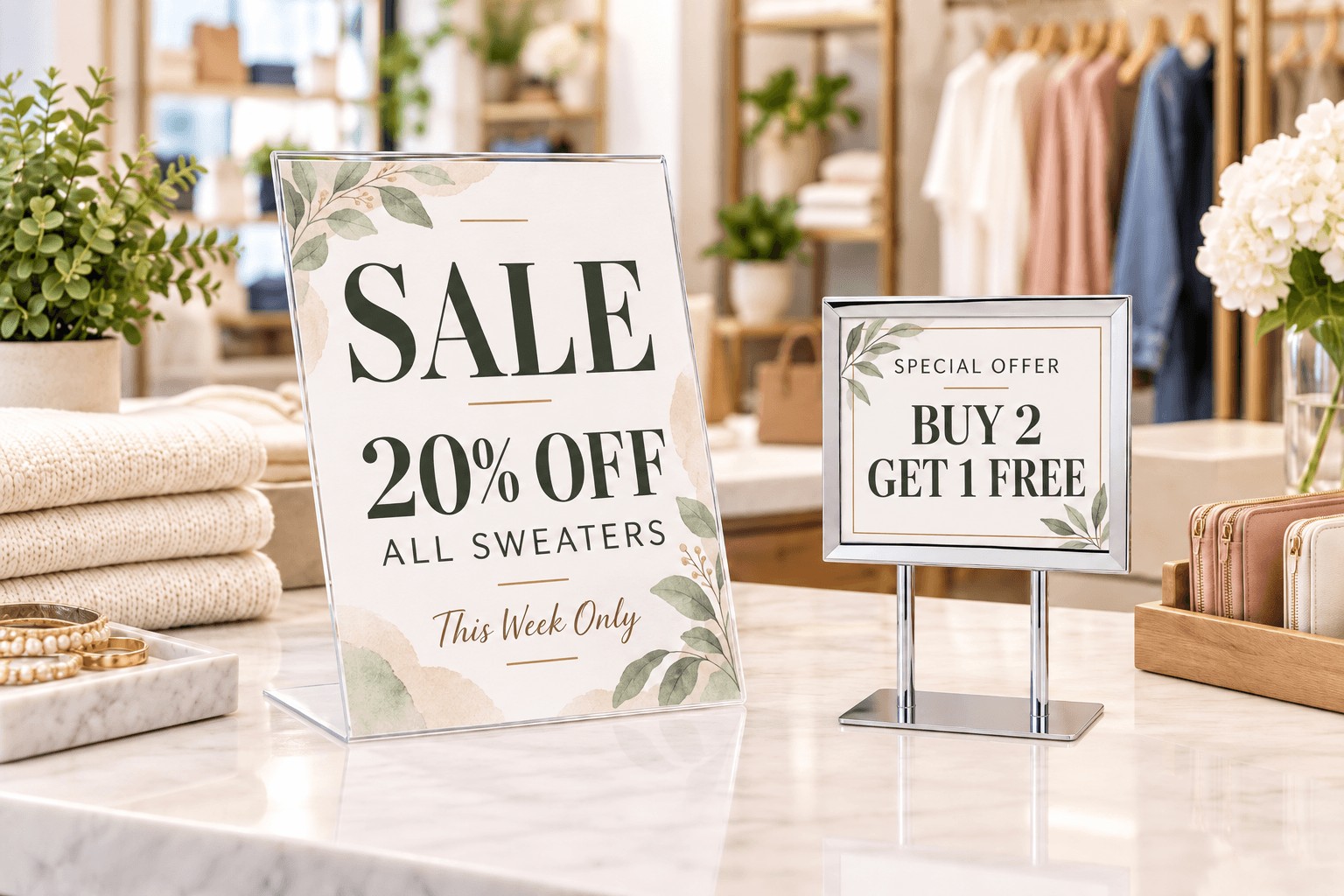
Signs do a lot of quiet work in a store. They announce a sale, confirm a price, and answer questions before a customer has to ask. But a sign only works when the size matches the message and the spot it sits in. Too big and it crowds the merchandise. Too small and shoppers walk right past it..
The two most common sign holder sizes
Most retailers end up building their signage around a couple of standard sizes because it keeps things simple and affordable. When your signs share a size, you can make them on your own paper, swap them fast, and keep a clean look across the store.
An 8.5 x 11 inch Single Sided Sign Holder fits a standard sheet of printer paper. That alone makes it the workhorse of retail signage. You can design a sign at your counter, print it, and drop it in with no trimming.
A 5.5 x 7 Countertop Sign Holder is the compact option. It holds a smaller card and reads more like a personal note than a poster. It sits close to the product without stealing the show.
When to use an 8.5x11 sign holder
Reach for the larger size when you need the message to carry across the store or grab attention from a few steps away. The 8.5 x 11 format gives you room for a headline plus a line or two of detail, and it stays readable from a distance.
Good jobs for an 8.5 x 11 sign:
- Promotions and sales. "20% Off All Sweaters" or "Buy One, Get One" deserves size. You want that read before a shopper reaches the rack.
- Department or category signs. Marking a section, a new arrivals table, or a clearance zone.
- Store policies and hours. Return windows, mask or pet policies, and holiday hours near the entrance or register.
- Event or seasonal announcements. Trunk shows, giveaways, or a grand reopening.
In my years helping independent shops set up their floorspace, the mistake I see most often with promo signs is going too small to save space. A sale sign that a customer has to lean in to read is a sale sign that does not sell. If the message is meant to pull people in, give it the larger frame.
When to use a 5.5x7 sign holder
The 5x7 size shines up close, where a customer is already standing at the product. It gives just enough space for a short message without turning a tidy display into a wall of paper.
Good jobs for a 5.5 x 7 sign:
- Product features and short descriptions. A few lines about a fabric, a maker, or why an item is special.
- Counter and register cards. "Ask about gift wrapping" or a note about a loyalty program where a customer will read it while checking out.
- Table and riser signs. A small card next to a featured item on a display cube or nesting riser.
- Short policy notes. "Please ask for help with the case" or "Cash only at this station."
The nesting risers and display cubes many customers use pair well with the smaller card. A 5.5 x 7 sits at eye level on a raised display without overwhelming the piece you worked to feature. If you build tabletop displays, browse our display cubes and risers to see how a small sign fills the space around a hero product.
What message length fits each size?
A quick rule I share with retailers: match the size to how many words a shopper needs and how far away they will read them.
|
Size |
Best for |
Message length |
Read from |
|
8.5 x 11 |
Promos, department signs, policies, events |
Headline plus a short supporting line |
Several steps away |
|
5 x 7 |
Product notes, counter cards, table signs |
A phrase or two, close reading |
Arm's length |
If you find yourself shrinking type to cram words onto a 5.5 x 7 card, that is your signal to move up to the larger format or cut the message down. Fewer words at a readable size will always beat more words a customer skips.
Shelf-edge versus counter signs
Where the sign lives matters as much as what it says. A freestanding frame on a counter has room to be larger. A sign clipped to a shelf edge does not.
For shelf-edge pricing and labels, neither of these frames is the right tool. Shelf edges call for a low-profile holder that clips to the lip so it does not block the product behind it. Our wood shelf ticket holder slips onto the edge of a wood shelf and holds a small price label, which keeps your gondola looking clean.
For counter and freestanding signs, you have the room to use either the 8.5 x 11 or the 5.5 x 7 depending on the message. A policy sign at the register can go larger. A quick note about an add-on service can stay small. Both can be found in our Retail Signs & Sign Holders section, so you can standardize on the sizes that fit your store.
A quick word on eye level and angle
Height changes everything. A sign at eye level can be smaller because the shopper is looking right at it. A sign down near the floor or up high needs more size to earn a glance. When in doubt, stand where your customer stands and see if you can read the sign without effort.
Building a consistent sign system
The retailers whose stores look the most put together tend to use just two or three sizes across the whole floor. That consistency reads as intentional, and it makes restocking signs a five minute job instead of a project.
A simple starting setup looks like this:
- 8.5 x 11 for anything meant to be seen from across an aisle: sales, sections, and store policies.
- 5 x 7 for anything read up close: product notes, counter cards, and table displays.
- A shelf-edge holder for prices and labels on wood shelving.
When you want a burst of color for a fast promotion, pre-printed cards can save you the design time. Our 7 x 5 fluorescent burst sign cards are sized for the smaller holder and made to pull attention to a featured item or a markdown.
One last thing worth checking before you order: confirm whether a frame stands vertically, horizontally, or both, and check the product page for exact dimensions and mounting style. A holder that matches your paper and your fixture will save you from trimming signs or hunting for a spot that fits. Get those two sizes working together and your signs will do their job without you thinking about them again.
Written by Kris Boettigheimer
Purchasing Assistant
Kris brings over 32 years of retail industry experience and more than 20 years at Store Supply Warehouse to every article he writes for storesupply.com. Since joining SSW in 2005, Kris has worked across multiple departments , including six years in Sales/Customer Service, where he helped independent retailers and small business owners find the right store fixtures, retail displays, and merchandising supplies to improve their store layouts and drive sales. For the past 15+ years in SSW's Purchasing Department, he has collaborated with suppliers, tracked market trends, and sourced products across all three Store Supply divisions. Today, Kris channels that hands-on experience into content that helps retailers enhance store presentation, discover new display solutions, and make smarter product decisions.