
Buying Shoe Displays for a High-Volume Thrift Store
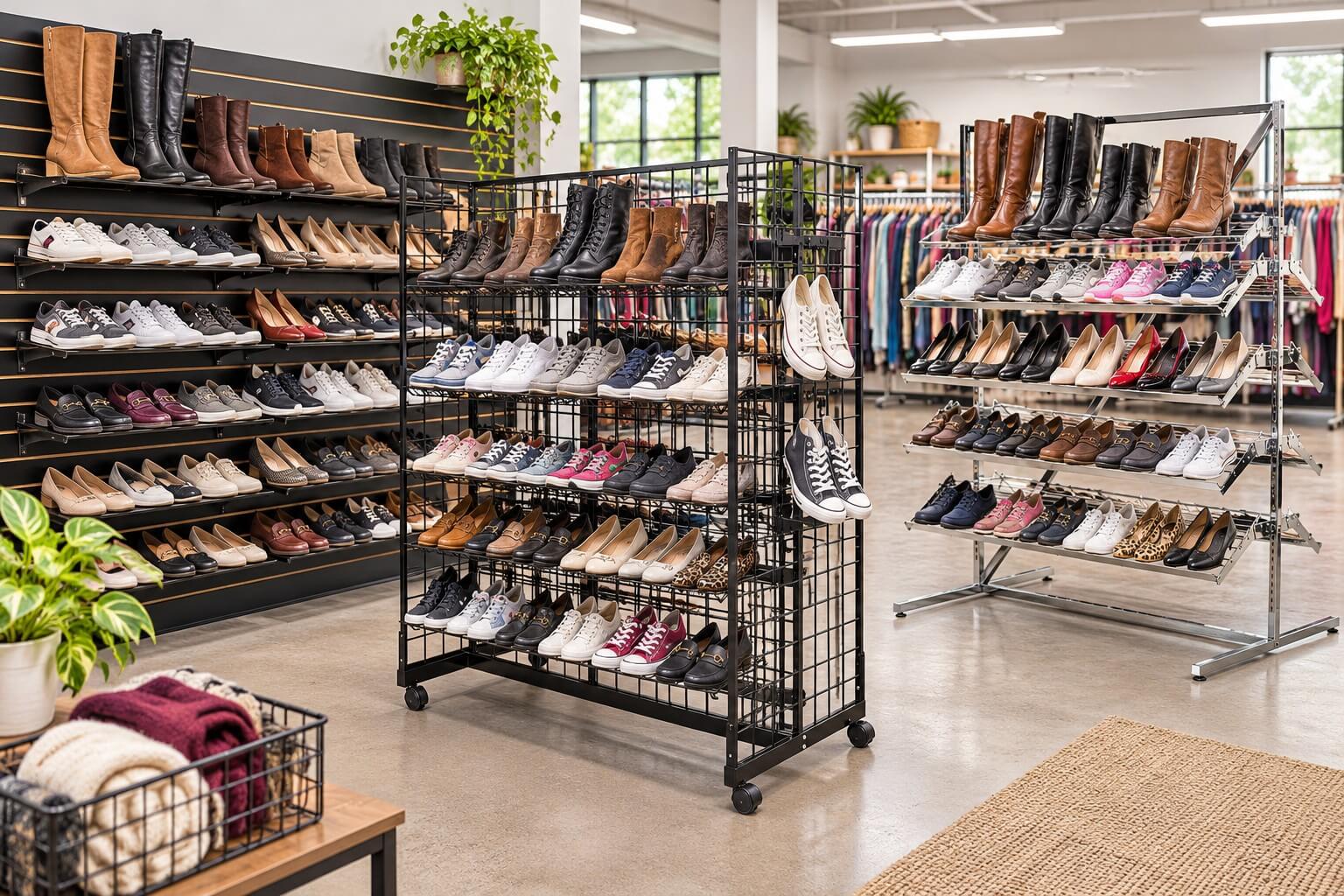
Shoes are one of the trickiest categories in a thrift store. Stock changes daily, styles and sizes are all over the map, and the volume never really slows down. When you buy shoe displays for a busy resale floor, you need fixtures that hold a lot, take some abuse, and let you rearrange quickly as inventory turns over.
In my years helping resale and consignment shops, the mistake I see most often is buying a fixture designed for 20 pairs of shoes, then trying to force too many pairs of shoes onto them. This guide walks you through what to buy for a high-volume setting, so you spend once and get it right.
What to Look For in Thrift Store Shoe Displays
Thrift Store fixtures live a harder life than most retail displays. Customers pick up, try on, and put back constantly, and your team restocks all day. Looks and style are great but there are some things you may want to consider first..
Durability comes first
Look for metal fixtures with a powder coat finish or wood shelving built for retail use. Powder coat resists chips and scuffs better than paint, which matters when shoes are sliding on and off shelves hundreds of times a week. Wire grid, slatwall, and gondola shelving are all built to take that kind of daily handling.
High capacity per square foot
In a thrift store, wall space is money. You want systems that let you stack shelves close together and run them floor to ceiling. Slatwall and Wire Grid both do this well because you can set shelf positions yourself instead of being locked into a manufacturer's spacing.
Fast restocking and easy browsing
Shoes sell when customers can scan a wall quickly and find their size. Angled or straight shelves that face the shoe outward help. Keep aisles clear and shelves at heights people can actually reach without bending over every pair.
Choosing a Shelving System: Slatwall vs. Wire Grid vs. Gondola
Most high volume shoe shelving in resale stores comes down to three systems. Each one handles differently, so match it to your space and your budget.
|
System |
Best For |
Notes |
|
Slatwall |
Clean wall runs and towers |
Shelves and brackets snap into grooves; looks finished; easy to rearrange |
|
Wire Grid |
Budget builds and flexible layouts |
Open look, lightweight, brackets and shelves attach anywhere on the panel |
|
Gondola |
Free-standing center aisles |
Double-sided runs pack in the most pairs per floor footprint |
For floor coverage, a slatwall tower gives you a self-contained, high-impact unit you can load with shelves and reconfigure as stock shifts. If you already run slatwall, you can add capacity with 12 inch metal shelf brackets for slatwall, which fit any standard 12 inch depth shelf and have an upturned notch at the tip for a secure hold.
If you want a lower-cost, flexible route, wire grid is hard to beat. A grid gondola unit turns standard wire grid panels into a portable, double-sided display. Browse our full range of Shoe Displays to compare options side by side.
How Many Shoe Shelves Do You Need for a Full Wall?
This is the question I get most, and the honest answer is: measure first, then do the math. Here is the approach I walk retailers through.
- Measure the wall width. Note the usable width in inches, minus any doors, outlets, or corners you cannot use.
- Divide by your shelf width. Most shoe shelves run in common widths like 24 inches. Divide the wall width by the shelf width to get shelves per row.
- Measure the usable height. Start about a foot off the floor and stop at a height staff can safely reach. Anything higher becomes hard to stock and hard to shop.
- Set your vertical spacing. Shoes need less height than most merchandise. Tighter spacing between shelves means more rows, which is exactly what you want in a thrift store.
- Multiply rows by shelves per row. That gives you total shelves. Then plan how many pairs fit per shelf so you know your wall's real capacity.
Because exact shelf and bracket dimensions vary by product, check the individual product pages for the sizes you are considering before you order. A quick sketch on paper with real measurements saves you from ordering too few shelves, which is the most common ordering error I see.
Are Adjustable Shoe Shelves Worth It for Changing Stock?
For a thrift store, yes. Adjustable shelving is worth it almost every time, and here is why.
Donated inventory is unpredictable. One week you get a run of kids' sneakers, the next it is winter boots that need twice the vertical clearance. Fixed shelving forces you to waste space above short shoes or leaves you no room for tall ones. With slatwall and wire grid, you move a bracket and the shelf resets to whatever height the stock needs.
That flexibility also speeds up seasonal changeovers. When sandals give way to boots, you drop a few shelves down, open up the gaps, and you are done. I have seen shops rework an entire shoe wall in an afternoon with adjustable systems, work that would mean buying new fixtures with a fixed setup.
Don't Forget Boots and Overflow
Tall boots are the one item that fights shelving. They flop over, take up space, and look messy on a flat shelf. A simple fix is hanging them. Padded boot clip hangers keep tall boots upright and paired, and they free up shelf space for the everyday shoes that move a little more quickly. They are sold by the case, so they scale well for a store with steady boot donations.
Round Out the Shoe Section
Once the shelving is set, a few small supplies keep the section shopping smoothly and moving inventory out the door:
- Clear pricing. Fast, visible tagging helps at checkout and cuts down on price questions. A 1-Line Pricing Gun and labels keep things consistent.
- Signage. Simple size or price signs help customers self-serve, which matters when your floor is busy and staff is stretched.
- Checkout bags. Drawtape bags are a solid pick for shoe retailers, since the draw tape handles close quickly and hold a boxed or loose pair securely for the trip home.
The main thing to remember is to buy fixtures that match how a thrift store actually runs: heavy volume, unpredictable stock, and a team that needs to restock fast. Pick a durable, adjustable system, measure your wall before you order, and add boot hangers for the odd sizes. Get those pieces right and your shoe section will keep pace with everything your donors send through the door.
Written by Kris Boettigheimer
Purchasing Assistant
Kris brings over 32 years of retail industry experience and more than 20 years at Store Supply Warehouse to every article he writes for storesupply.com. Since joining SSW in 2005, Kris has worked across multiple departments , including six years in Sales/Customer Service, where he helped independent retailers and small business owners find the right store fixtures, retail displays, and merchandising supplies to improve their store layouts and drive sales. For the past 15+ years in SSW's Purchasing Department, he has collaborated with suppliers, tracked market trends, and sourced products across all three Store Supply divisions. Today, Kris channels that hands-on experience into content that helps retailers enhance store presentation, discover new display solutions, and make smarter product decisions.