What Is a Hangrail and How Does It Fit Your Wall Standards?
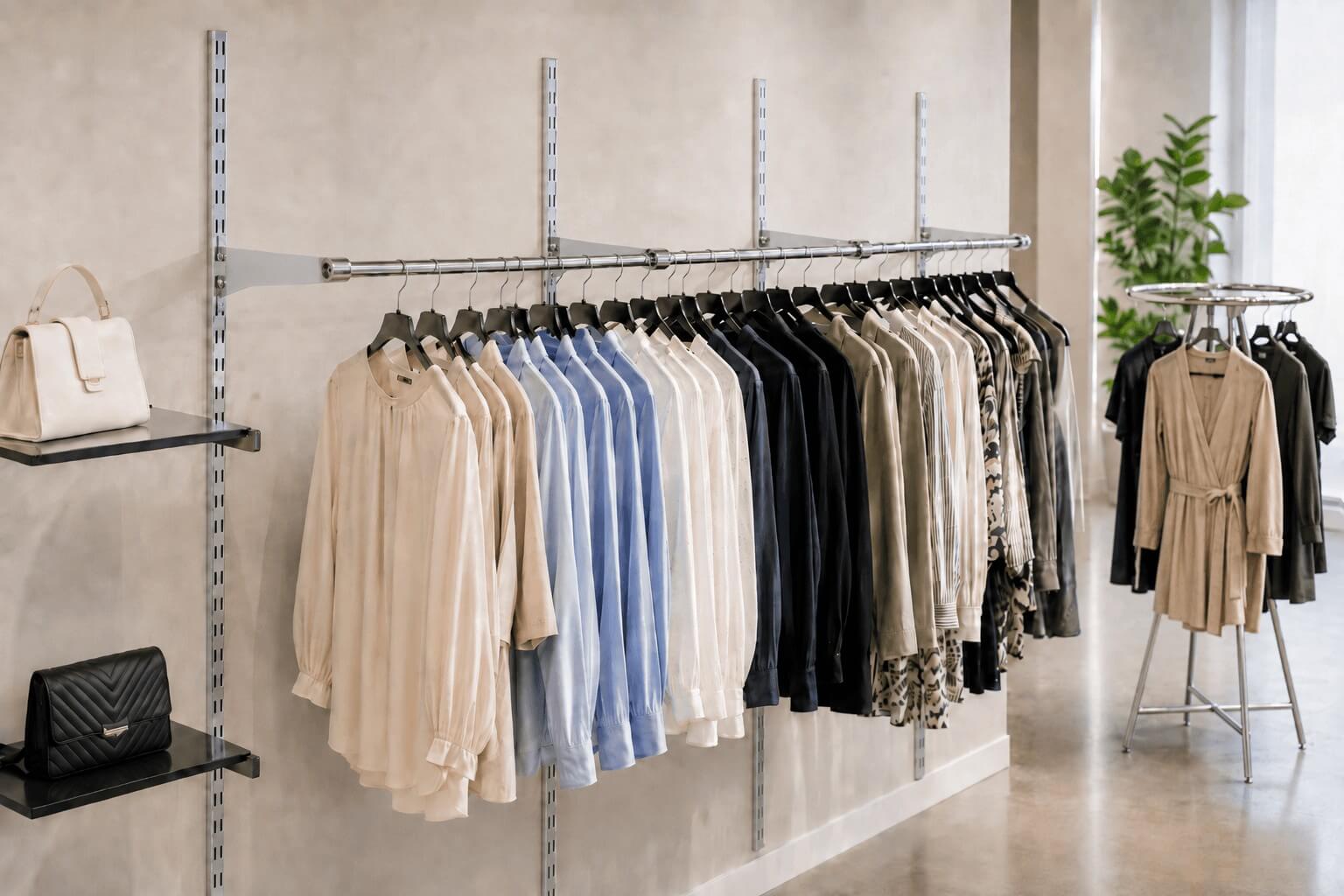
If you have ever walked into a clothing store and seen rows of shirts and jackets hanging at a steady height, you were seeing a hangrail at work. It is one of those fixtures that does its job quietly, so most shoppers never notice. For a store owner, though, the hangrail is one of the things that holds a wall display together.
What Is a Hangrail?
A hangrail is a horizontal bar that holds clothing. In a wall system, it runs between supports so garments can be hung from hangers. Think of it as the bar your customers reach toward when they flip through a row of clothing.
The word "rail" is the key part. It is not a shelf and it is not a hook. It is a length of tube or bar designed to carry hangers across a span of wall. Most apparel walls are built from vertical supports plus the hangrails and brackets that hang merchandise.
Hangrail Versus a Faceout
People sometimes mix these up. A hangrail runs side to side and shows garments from the shoulder out, so customers can flip through them. A faceout sticks straight out from the wall and shows the garment from the front. Most wall systems use both: faceouts to feature a look and hangrails to hold the stock and different sizes.
How Does a Hangrail Attach to Slotted Standards?
This is where the wall system comes together. A slotted standard is the vertical metal upright mounted to your wall. It has a series of slots running down its length. Those slots are what everything else hooks into.
Here are the basic parts on a standards-and-brackets wall:
- Slotted standard: the vertical upright with slots, fastened to the wall.
- Bracket: hooks into the slots and reaches out from the wall.
- Hangrail: rests on or attaches to the brackets and spans the gap between them.
The 12" Dimensional Bracket is the connector piece that makes it all work. The bracket holds firm under the weight of the merchandise. The 4 foot Dimensional Hangrail then sits across two or more brackets to create a continuous bar.
A few practical points I share with retailers:
- Make sure to use brackets in matching slots on each standard so your hangrail stays level. A crooked rail is the fastest way to make a tidy wall look sloppy.
- Be sure each bracket is fully seated in its slot before you load weight onto it.
- For long runs, you may need more than two brackets so the rail does not sag in the middle.
When a single hangrail is not long enough for your wall, a splicer joins two lengths together. Our chrome dimensional hangrail splicer connects two pieces for a cleaner, continuous look across a longer span.
Hangrails on Other Wall Systems
Slotted standards are common, but they are not the only wall you will run into. The same idea shows up on grid and on freestanding fixtures, just with different connectors.
|
Wall system |
How the hangrail connects |
|
Slotted standards |
Brackets hook into slots, hangrail rests on brackets |
|
Wire grid |
A U-shaped rail or bracket hooks directly onto the grid wires |
|
Round and 4-way racks |
The hangrail is built into the fixture as the hanging arm |
On Grid Wall & Wire Grid , you can skip separate brackets. Our U-shaped hangrail for wire grid hooks right onto the panel and gives you a hanging bar without adding much weight to the display.
Freestanding racks have the rail built in. A chrome collapsible round clothing rack, for example, uses a round hangrail as its hanging surface, so there is nothing extra to attach. You can browse more of these in our clothing racks selection.
What Kinds of Merchandise Hang on a Hangrail?
Just about anything that goes on a hanger can be used on a hangrail.
- Shirts, blouses, and tees
- Dresses
- Jackets and light coats
- Pants and skirts on clamp or bar hangers
- Sample garments and seasonal lines
The hangrail itself only does half the job. The hangers you pair with it matter just as much. Lightweight tops do fine on molded plastic hangers, while heavier pieces hold their shape better on sturdier metal. You can match your rail to the right hanger style from our Wholesale Clothes Hangers category.
Keep the Rail Shoppable
In my years helping store owners set up apparel walls, the mistake I see most often is overpacking the hangrail. When garments are crammed shoulder to shoulder, customers stop flipping through them because it is too much work. Leave breathing room and your sales floor reads as organized instead of crowded.
Size dividers are a small fix that makes a big difference here. Attaching a divider onto the rail between sizes lets customers find their size fast and helps your staff keep the run in order. Our round size dividers for hangrails slide right onto the bar and earn their keep on any busy wall.
Picking the Right Hangrail for Your Store
When you are deciding what to buy, walk through these questions:
- What wall do you have? Slotted standards, grid, and slatwall each use different parts. Match your hangrail and bracket to the system already on your wall.
- How long is the run? Measure the space between your standards so you order the right length, and plan for a splicer if you are joining pieces.
- What are you hanging? Heavier merchandise calls for more support points and the right brackets. Check each product page for exact dimensions and any load information before you load up a wall.
- What is the look? Chrome, black, and other styles change the feel of the wall. Keep finishes consistent for a put-together display.
The Short Version
A hangrail is the horizontal bar that holds your hanging clothes. On a wall system, brackets hook into the slots of a vertical standard, and the hangrail sits across those brackets to span the wall. Pair it with the right hangers and size dividers to give your garments room to breathe, giving you a display wall that is easy to shop and keep neat.
Written by Kris Boettigheimer
Purchasing Assistant
Kris brings over 32 years of retail industry experience and more than 20 years at Store Supply Warehouse to every article he writes for storesupply.com. Since joining SSW in 2005, Kris has worked across multiple departments , including six years in Sales/Customer Service, where he helped independent retailers and small business owners find the right store fixtures, retail displays, and merchandising supplies to improve their store layouts and drive sales. For the past 15+ years in SSW's Purchasing Department, he has collaborated with suppliers, tracked market trends, and sourced products across all three Store Supply divisions. Today, Kris channels that hands-on experience into content that helps retailers enhance store presentation, discover new display solutions, and make smarter product decisions.