
What Does a Slotted 'Standard' Actually Do on Your Wall?
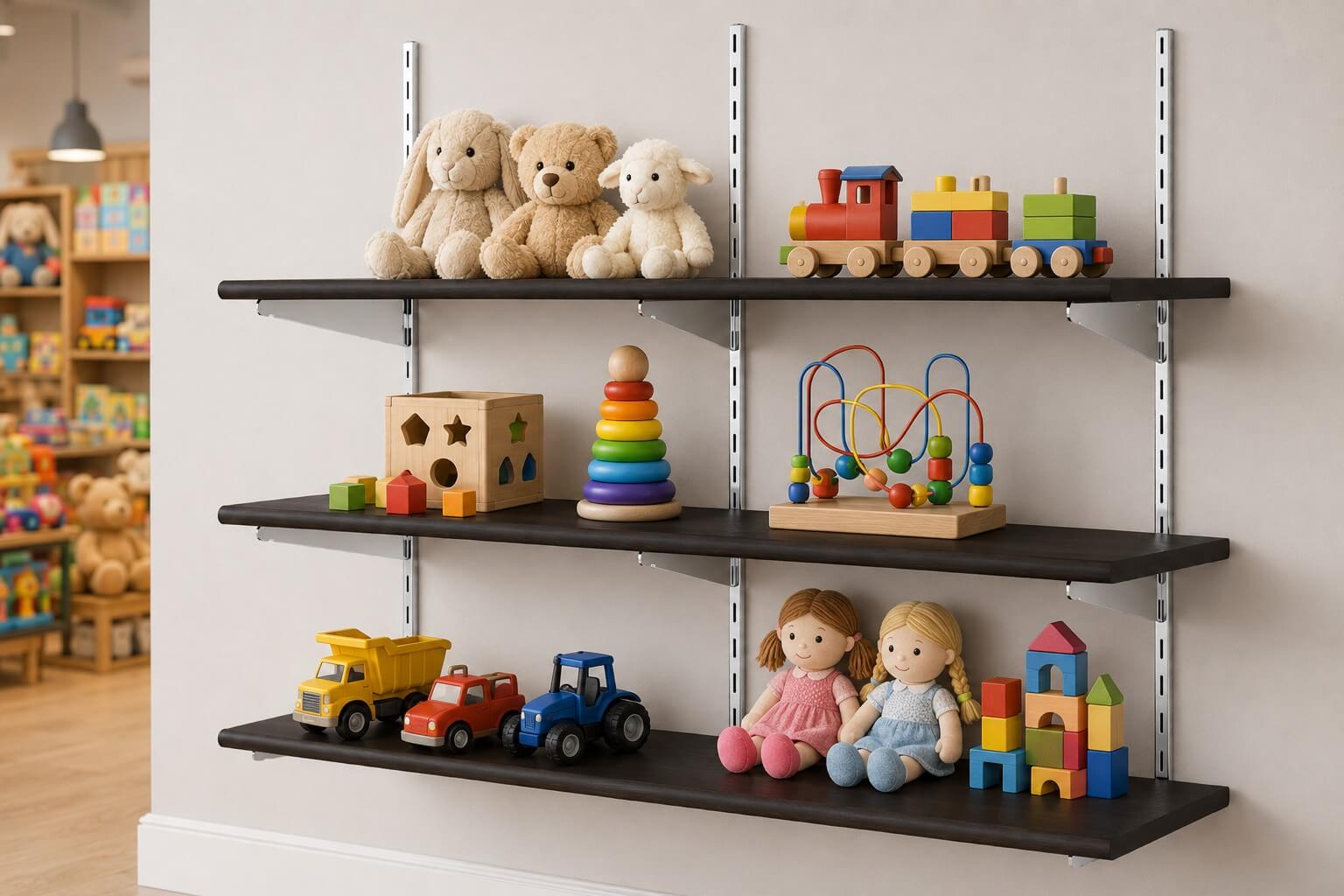
If you have ever looked at a retail wall and noticed a thin vertical metal strip with a row of small slots running down it, you have seen a slotted standard. It is one of the most common pieces in store fixturing, and also one of the least understood. Customers never notice it. Retailers often do not think about it until a shelf will not hold or a wall layout needs changing.
Slotted standards are often the quiet workhorse behind a lot of wall displays. Let's walk through what they actually do, how they work with brackets and shelves, and why they carry such an odd name.
What Is a Slotted Standard?
A slotted standard is a wall mounted vertical metal upright with a series of evenly spaced slots cut into it. They are designed to accept the hooks or tabs on the back of a shelf bracket and hold it in place.
On its own, a standard does not display anything. It is the anchor point. Think of it as the backbone of your wall system. Brackets, shelves, and faceouts hang from it, with the slots deciding where each piece will sit.
The Basic Parts of a Standard Wall System
- The standard: the slotted vertical upright that mounts to the wall or fixture.
- The bracket: the arm that hooks into the slots to carry a shelf or rail.
- The shelf or accessory: the surface or holder that rests on the brackets and presents your merchandise.
All three work together. Remove any one and the system does not function.
What Is the Function of a Slotted Standard on a Store Wall?
The main job of a standard is to give you adjustable mounting points. Instead of drilling a new hole every time you want to move a shelf, you mount the standard once and then move brackets up and down the slots as your needs change.
That flexibility is the whole point. A standard lets you:
- Change shelf height without new holes in the wall.
- Reconfigure a wall for a new season or a new product line.
- Mix shelves, faceouts, and hangrails on the same vertical run.
- Spread weight across a wall in a controlled, repeatable way.
How Does a Slotted Standard Support Adjustable Shelving?
The connection between the standard and the bracket is what makes adjustable shelving possible. Here is the sequence in plain terms.
- The standard is mounted vertically and level on the wall, with its slots facing out.
- A bracket has matching tabs or hooks on its back edge.
- You insert those tabs into the slots at the height you want, then set the bracket so it locks against the standard.
- You repeat with a second bracket on a parallel standard so the pair sits at the same height.
- A shelf is placed across the two brackets, and the shelf is now supported and level.
Because the slots run the full length of the standard, you can lift the brackets out and reset them higher or lower in minutes. That is the difference between an adjustable wall and a fixed one.
Brackets Are Built for the System They Match
Brackets are not all interchangeable. A bracket is designed to fit a specific wall system, and you want the bracket, the standard, and the shelf depth to be matched. For example, our 12 inch shelf brackets for slatwall can be used with any standard 12 inch depth shelf and feature an upturned notch at the tip for a more secure fit. If you run a wire grid wall instead, the 14 inch shelf brackets for wire grid serve the same purpose for that system.
The takeaway: confirm what wall system you have before you buy brackets. The slot pattern, the channel size, and the bracket back all need to match. Check each product page for exact dimensions and the shelf depths a bracket is built to carry.
Why Is It Called a 'Standard' in Retail Fixtures?
This is the question I get most when someone first sets up a wall. The name throws people off because in everyday language a standard means a rule or a level of quality. In the fixture world, the word is used in a different sense: a standard is an upright support that display items hang from.
So when a supplier says standard, they mean the vertical slotted upright, not a quality grade. Once you hear the word used that way, the rest of the terminology will make sense.
Where Standards Fit Among Other Wall Systems
Slotted standards are one approach to building a flexible wall. Other systems solve the same problem in different ways, and many stores use a mix. Here is a quick comparison.
|
System |
How it holds merchandise |
Good to know |
|
Slotted standard and bracket |
Brackets hook into slots on a vertical upright |
Adjustable height, mix shelves and faceouts on one run |
|
Slatwall |
Hooks, faceouts, and brackets sit in horizontal grooves |
Continuous mounting across the whole panel |
|
Wire grid |
Accessories clip onto a welded wire panel |
Lightweight and portable, easy to reconfigure |
If you are leaning toward a panel based wall instead of standards, check out our selection of Slatwall Panels, Displays & Accessories for the hooks, faceouts, and brackets that fit that system. For a freestanding or portable grid display, our Grid Wall & Wire Grid section covers shelves, baskets, and hangrails designed for that system.
Practical Tips Before You Buy and Mount
- Mount level and plumb. A standard that leans even slightly will throw off every shelf above it.
- Match the run heights. Brackets on parallel standards must sit in slots at the same level so the shelf lays flat.
- Buy brackets and shelves as a set. Confirm the shelf depth your bracket is rated to carry on the product page.
- Do not overload. Spread heavy stock across brackets rather than crowding one shelf.
- Plan your spacing. Decide your tallest and heaviest items first, then space standards to support them.
One more lesson. I have seen retailers buy shelves only to discover the brackets do not fit their existing standards. Measure your slot spacing and channel before ordering,
The Bottom Line
A slotted standard is the vertical anchor of an adjustable wall. Its slots give brackets a place to lock in, and those brackets carry the shelves and faceouts that show your merchandise. The system earns its keep by letting you change heights and layouts without rebuilding the wall.
Once you understand the standard wall function, the rest of your wall planning gets easier. You start with solid, level uprights, match your Retail Outrigger Accessories and build out from there. If you want to round out a wall display with shelves or browse our selection of Slatwall Shelves to see what pairs with your setup.
Written by Kris Boettigheimer
Purchasing Assistant
Kris brings over 32 years of retail industry experience and more than 20 years at Store Supply Warehouse to every article he writes for storesupply.com. Since joining SSW in 2005, Kris has worked across multiple departments , including six years in Sales/Customer Service, where he helped independent retailers and small business owners find the right store fixtures, retail displays, and merchandising supplies to improve their store layouts and drive sales. For the past 15+ years in SSW's Purchasing Department, he has collaborated with suppliers, tracked market trends, and sourced products across all three Store Supply divisions. Today, Kris channels that hands-on experience into content that helps retailers enhance store presentation, discover new display solutions, and make smarter product decisions.