Poly Mailer vs. Bubble Mailer: Which for Your Home Sales?
If you sell from home, the package you choose matters as much as the product inside it. Pick the wrong mailer and you either pay too much or risk a damaged item and a return. Pick the right one and your shipping stays affordable while your buyer gets a clean, protected package.
In my years helping small sellers choose packaging, the question I hear most often is simple: do I need a flat poly mailer or a padded bubble mailer? Here is how I help people sort it out.
The Short Answer First
Use a flat poly mailer for soft, bendable, non-fragile items. Use a padded bubble mailer when the item could scratch, dent, crack, or break.
That one rule covers most home sales. The rest of this article explains why, so you can make the call confidently for whatever you ship.
What a Poly Mailer Is Best For
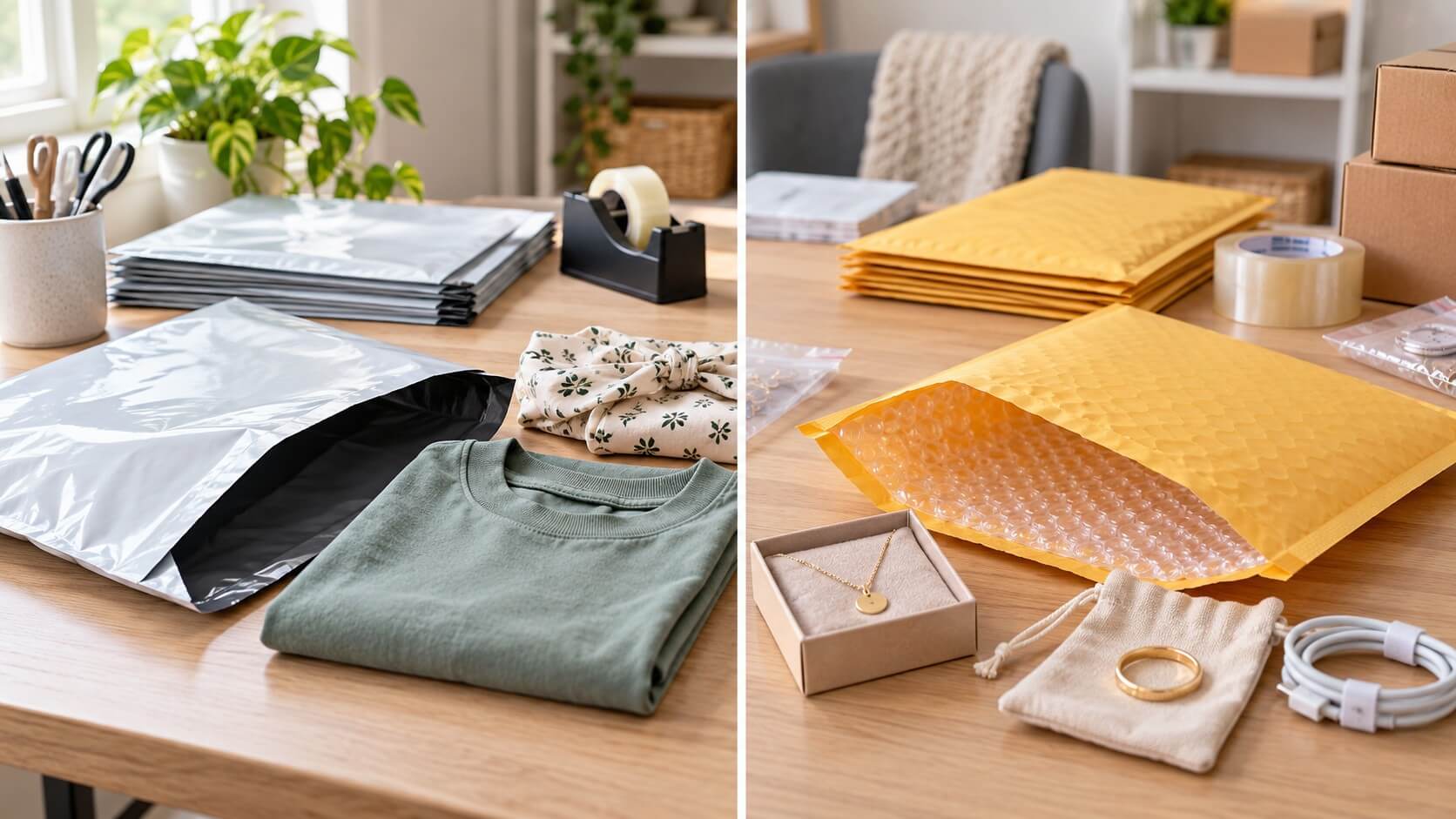
A Poly Mailer is a flat, lightweight plastic envelope. It has no padding. Its job is to keep contents dry and hidden, not to cushion them.
Poly mailers shine with items that bend without harm:
- Clothing, T-shirts, and soft goods
- Fabric items, scarves, and linens
- Printed material that does not need to stay rigid
- Anything soft that squishes into a flat shape
Because they are thin and light, poly mailers add almost nothing to package weight. For home sellers watching postage, that weight savings adds up across many orders. If you ship apparel, a poly mailer is usually the right starting point.
What a Bubble Mailer Is Best For
A Bubble Shipping Bag (the padded mailer) has a layer of bubble cushioning bonded to the inside. That padding absorbs shocks and protects against bumps during transit.
Reach for a padded mailer when the item has edges, corners, a hard surface, or any risk of breaking:
- Jewelry and small accessories with clasps or stones
- Electronics, cables, and small gadgets
- Books and media with corners that can crush
- Ceramics, framed prints, and other fragile pieces
- Anything with a finish that scratches easily
The honest answer to which mailer protects fragile items better in transit is the bubble mailer. The padding does work that flat plastic simply cannot. When in doubt about fragility, the padded option is the safer choice.
Flat vs. Padded Mailer: A Side-by-Side Look
|
Factor |
Poly Mailer (Flat) |
Bubble Mailer (Padded) |
|
Protection |
Water resistant, no cushioning |
Water resistant plus shock cushioning |
|
Best items |
Soft, bendable goods |
Fragile or hard items |
|
Added weight |
Very low |
Higher than flat poly |
|
Cost per unit |
Usually lower |
Usually higher |
|
Storage space |
Compact and flat |
Bulkier due to padding |
Which One Costs Less Per Unit?
In general, a flat poly mailer costs less per unit than a padded bubble mailer. You are paying for less material and no cushioning layer.
But unit price is only half the story. A padded mailer that prevents one broken item can save you more than the small price difference across a whole batch of poly mailers. When I worked in customer service, the sellers who tried to save a few cents by shipping fragile goods flat were often the same ones dealing with refunds and replacements later.
Think in terms of total cost: the mailer price plus the postage plus the risk of damage. For soft goods, poly wins on every count. For fragile goods, the extra padding usually pays for itself.
Weight and Postage Matter More Than You Think
Shipping costs often come down to weight and size. A flat poly mailer keeps packages thin and light, which can help with postage on soft items.
A bubble mailer weighs a bit more because of the padding, but it can still ship lighter and cheaper than putting a fragile item in a box with loose fill. For many small, breakable products, a padded mailer is the sweet spot between a flimsy flat envelope and a bulky box.
Presentation Counts for Home Sellers
Your package is the first thing a customer touches. A clean, well-chosen mailer tells buyers you take your small business seriously, and that impression drives repeat orders and reviews.
Consider small touches that match the mailer to the product. A thank you card, a branded sticker, or tidy interior packaging makes the unboxing feel considered. For fragile items, that padded layer also signals care before the buyer even opens the package.
A Simple Decision Checklist
Before you pack an order, ask yourself three quick questions:
- Can it bend without harm? If yes, a poly mailer will likely do the job.
- Does it have hard edges, a breakable surface, or moving parts? If yes, choose a padded mailer.
- Would a scratch or dent trigger a return? If yes, add the padding and ship with confidence.
When an answer is unclear, lean toward protection. A return costs you the item, the return postage, and the customer's trust.
Round Out Your Shipping Station
Whichever mailer you choose, a few supporting supplies keep your packing fast and consistent. In our Packing and Shipping Supplies section, you will find options that fit different products and order sizes.
For loose small items like jewelry, beads, or hardware, drop them into resealable clear plastic bags before they go into the mailer. That inner layer keeps parts from shifting and adds a tidy finish.
One habit I always recommend: buy mailers in the one or two sizes you use most, rather than a drawer full of odd sizes you reach for twice a year. Standardizing your packaging speeds up every shipment and makes your postage more predictable, which is exactly what a busy home seller needs.
Written by Kris Boettigheimer
Purchasing Assistant
Kris brings over 32 years of retail industry experience and more than 20 years at Store Supply Warehouse to every article he writes for storesupply.com. Since joining SSW in 2005, Kris has worked across multiple departments , including six years in Sales/Customer Service, where he helped independent retailers and small business owners find the right store fixtures, retail displays, and merchandising supplies to improve their store layouts and drive sales. For the past 15+ years in SSW's Purchasing Department, he has collaborated with suppliers, tracked market trends, and sourced products across all three Store Supply divisions. Today, Kris channels that hands-on experience into content that helps retailers enhance store presentation, discover new display solutions, and make smarter product decisions.