Poly Mailer or Box? Choosing Shipping Packaging at Home
If you run an online shop from your kitchen table or spare bedroom, packaging is one of the first real decisions you make for every order. Grab a poly mailer, or reach for a box? The answer changes your shipping cost, how your item arrives, and how your packing station looks at the end of a busy week.
In my years helping independent sellers and small business owners, the packaging question comes up constantly, usually right after someone realizes shipping is eating into their margin. Let me walk you through how to decide, item by item.
The Short Answer: Match the Package to the Product
There is no single right choice. The smart move is to match the packaging to what you are actually shipping. A soft, bend-friendly item behaves very differently in transit than something with corners, glass, or parts that can snap.
Before you default to one or the other, ask yourself three quick questions:
- Is the item soft and flexible, or rigid and breakable?
- Does it need structure to keep its shape?
- How much does dimension and weight affect what the carrier charges me?
Those three answers point you toward a poly mailer or a box almost every time.
When a Poly Mailer Makes Sense
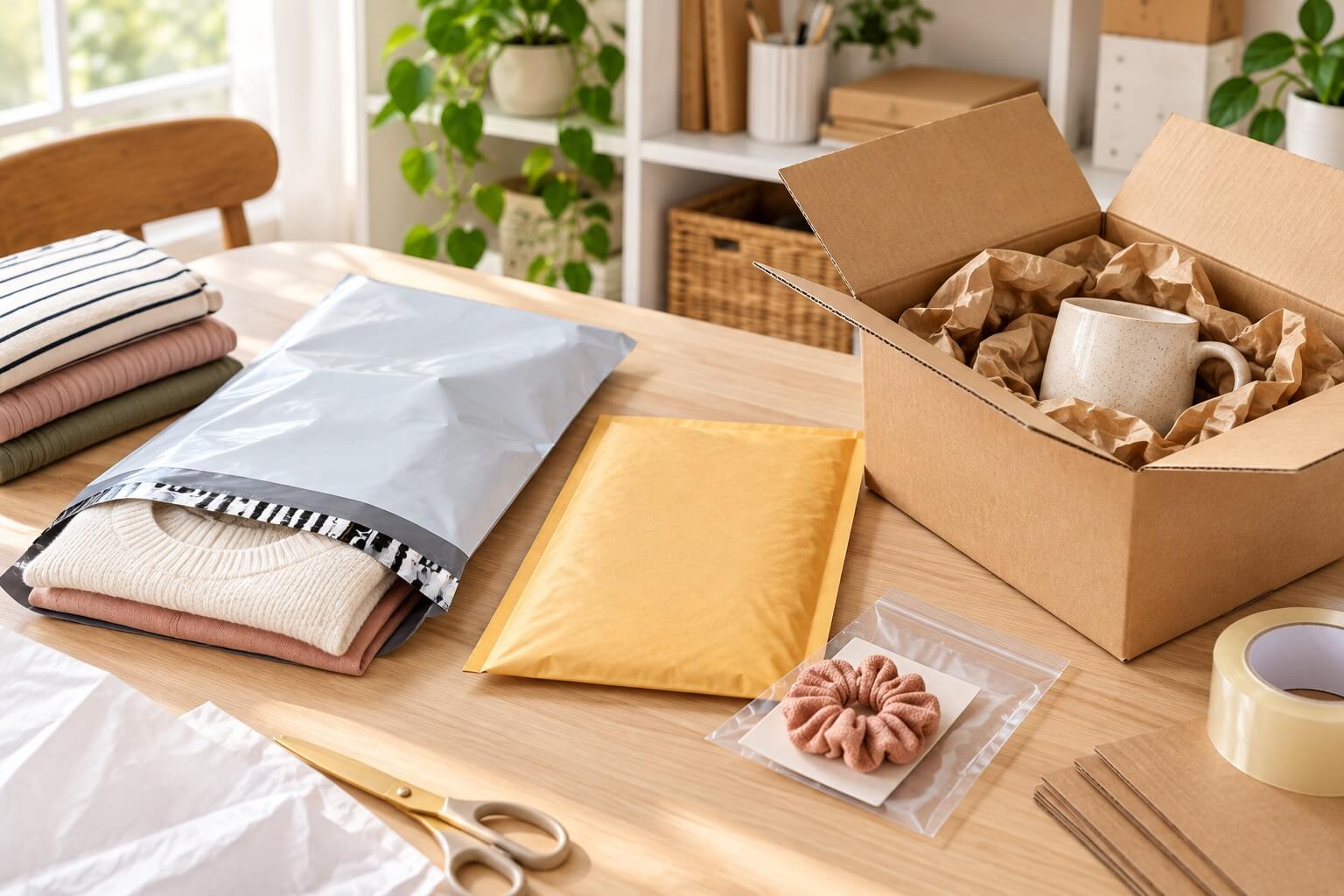
Poly Mailers are lightweight plastic envelopes. They shine with soft goods that can bend without harm. Think apparel, fabric items, and anything that will not be damaged by pressure or a little flex.
Good candidates for a poly mailer include:
- T-shirts, leggings, and other folded clothing
- Scarves, hats, and soft accessories
- Blankets and textiles
- Non-fragile items that are hard to crush
The appeal is simple. Mailers add almost no weight of their own, they take up little space in your packing area, and they are quick to fill and seal. For a home business shipping a steady flow of soft goods, that speed adds up over a month.
Padded Mailers for a Little Extra Protection
When an item is mostly soft but has a part you want to cushion, a Padded Mailer bridges the gap. The padding guards against scuffs and light bumps without the bulk of a box. It still will not protect anything from a hard crush, so save padded mailers for items that can take a knock but prefer not to.
When You Need a Box Instead
Shipping Boxes earns their keep when the item cannot bend, cannot be crushed, or needs to hold its shape. The rigid walls do the protecting, and you fill the empty space with cushioning so nothing shifts.
Reach for a box when you are shipping:
- Glass, ceramics, candles, and anything breakable
- Electronics or items with components that can snap
- Products that must arrive uncrushed, like gift sets or structured hats
- Items with sharp corners that would poke through a mailer
- Anything heavy enough to tear a thin envelope
Here is a mistake I saw often when I worked in customer service: a seller ships a fragile item in a mailer to save a few cents, it arrives broken, and now they are covering a replacement plus a second shipping charge and an unhappy buyer. The box would have been the cheaper choice all along once you count the do-over.
Which Is Cheaper to Ship: Padded Mailer or Small Box?
For most lightweight items, a padded mailer usually costs less to ship than a small box, and the reason is dimensional weight. Carriers often price packages on size as well as actual weight. A flat, thin mailer has a smaller footprint than a box of the same contents, so it frequently lands in a lower rate.
That said, the gap narrows or flips in a few situations:
- Flat-rate options. If your item fits a flat-rate box, the box can win regardless of its shape.
- Heavy items. Once weight drives the price, the mailer's size advantage matters less.
- Damage risk. A broken item shipped in a mailer is never the cheaper option after the refund.
My advice: weigh and measure a real, packed sample of each option, then compare the actual quote from your carrier. Rates and rules change, so check current numbers rather than guessing.
Quick Comparison
|
Factor |
Poly Mailer |
Box |
|
Best for |
Soft, flexible goods |
Fragile or rigid goods |
|
Protection |
Low to moderate (padded) |
High with cushioning |
|
Weight added |
Very little |
More |
|
Shipping cost |
Often lower for light items |
Can be higher unless flat-rate |
|
Storage at home |
Flat, compact |
Takes more space |
|
Packing speed |
Fast |
Slower, needs fill |
Don't Forget the Finishing Touches
Whichever you choose, the unboxing moment still counts, even for a home business. A small branded touch inside the shipment goes a long way. A thank-you note, a bit of Tissue Paper , or a reusable bag tucked around the product makes a buyer remember you.
For loose or small items that go inside a mailer or box, protect them first with something like resealable clear plastic bags, which keep jewelry, beads, and other small pieces together and shielded from moisture. If you sell apparel and want a presentation-forward option, a paper gift bag or paper shopping bag can serve as interior packaging that doubles as a nice extra.
You can round out your packing station from our Packaging Supplies category, which covers mailers and boxes in one place so you can standardize what you reach for on each order.
A Simple System to Decide Fast
Once your orders pick up, you will not want to re-think this every time. Set a rule for each product you sell. Soft and bendable goes in a mailer. Fragile or rigid goes in a box. Borderline items get a padded mailer. Write it down, label your supply shelves, and anyone helping you pack will get it right without asking.
The sellers who stay profitable are the ones who treat packaging as a decision made once per product, not once per order. Decide your rules, buy the right supplies in quantities that match your volume, and your packing time and your shipping costs both come down. That consistency is what keeps the back-of-house part of your business from slowing down the front.
Written by Kris Boettigheimer
Purchasing Assistant
Kris brings over 32 years of retail industry experience and more than 20 years at Store Supply Warehouse to every article he writes for storesupply.com. Since joining SSW in 2005, Kris has worked across multiple departments , including six years in Sales/Customer Service, where he helped independent retailers and small business owners find the right store fixtures, retail displays, and merchandising supplies to improve their store layouts and drive sales. For the past 15+ years in SSW's Purchasing Department, he has collaborated with suppliers, tracked market trends, and sourced products across all three Store Supply divisions. Today, Kris channels that hands-on experience into content that helps retailers enhance store presentation, discover new display solutions, and make smarter product decisions.