Outrigger vs. H-Rack for a High-Volume Thrift Store Floor
If you run a busy thrift operation, your fixtures take a beating. Inventory turns over fast, donations arrive in waves, and your team has to get racks restocked while customers are shopping the floor. The fixture you choose changes how much you can display, how quickly you can refill it, and how long it lasts before it needs replacing.
Two of the most common choices for hanging apparel at volume are outrigger systems and H-racks. Below I'll walk through how each one works, which holds more, and which is easier to keep full during a rush.
What Is an Outrigger System?
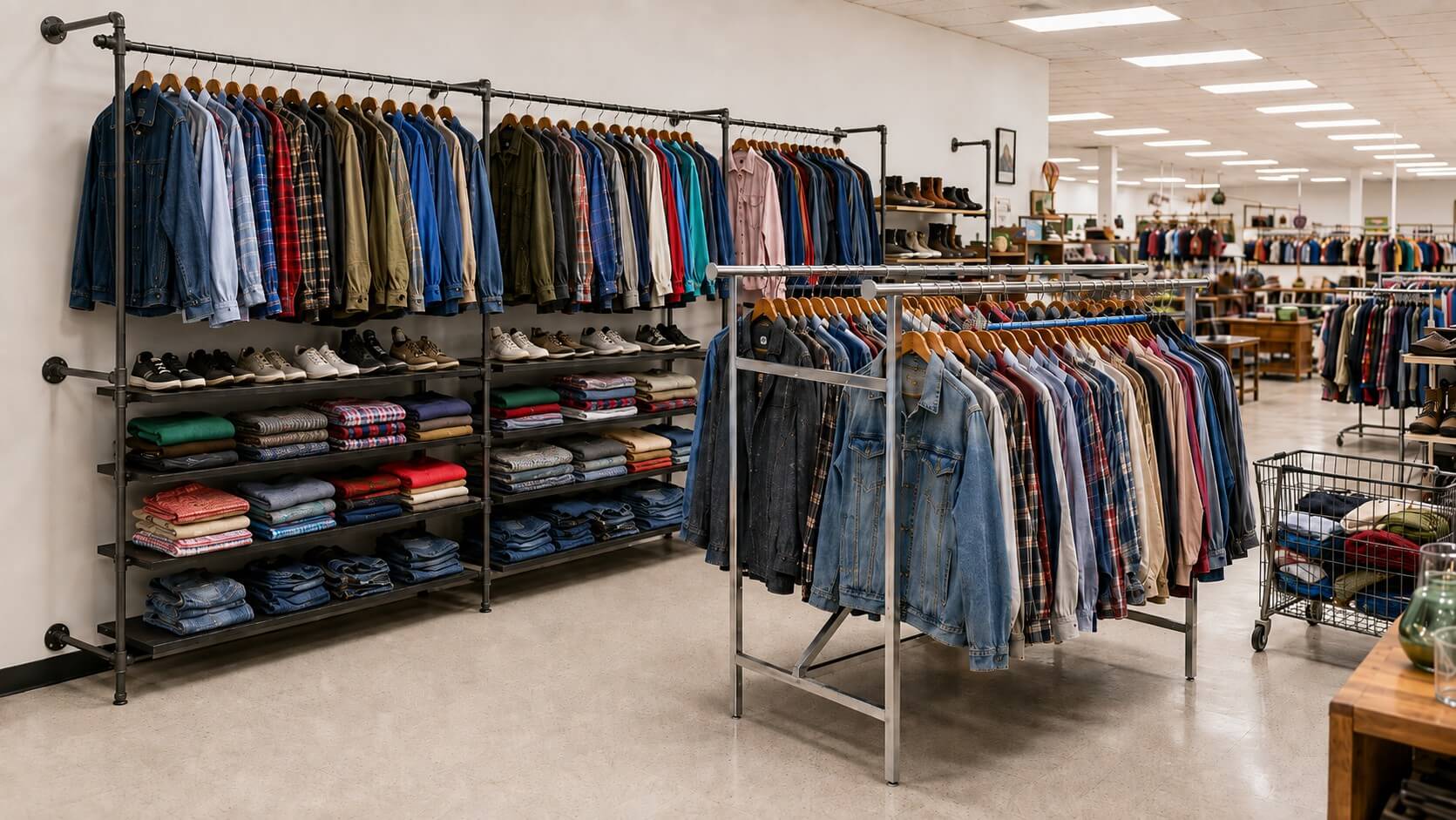
An outrigger is a wall-based or upright-based system. Vertical posts mount to a wall and arms (called outriggers) extend out from those posts. You then load hangrails, faceouts, baskets or shelves onto the arms.
The key idea is that an outrigger builds upward along a wall. You're using vertical height and your perimeter to hold merchandise, which keeps the center of your floor more open. Outriggers also accept add-ons. For example, you can drop a caramel oak shelf made for outrigger systems onto the arms to mix folded goods and shoes in with your hanging apparel.
What Is an H-Rack?
An H-rack, sometimes called a Double-Rail Clothing Rack gets its name from its shape. Picture two upright end frames connected by long horizontal hangrails, forming an H when you look at it from the side.
H-racks sit out on the open floor. They hold a lot of garments in a small footprint and let customers shop from both sides. For a thrift store moving high garment counts, that double-sided, double-rail design is the main draw.
Outrigger vs. H-Rack: Side by Side
|
Factor |
Outrigger System |
H-Rack |
|
Placement |
Wall or upright mounted, uses perimeter |
Freestanding, anywhere on the floor |
|
Density |
High, builds up vertical wall space |
High, adjustable rails and two shopping sides |
|
Flexibility |
Add shelves, baskets, and hangrails |
Mostly straight hanging |
|
Restock access |
One side, but multiple levels |
Both sides at once |
|
Floor flow |
Keeps center aisles open |
Defines aisles and zones |
Which Holds More Inventory for a Thrift Store?
This depends on your space more than the fixture itself.
If you have long, usable wall runs, an outrigger system wins on raw capacity. You stack hangrails and shelves up the wall, so you're using height that an H-rack can't reach. A wall lined with outriggers can hold a serious amount of apparel without crowding your aisles.
If your floor is wide and open with limited wall space, the H-rack pulls ahead. Each unit gives you two rails and two shopping sides, and you can line up several down the middle of the room. For pure garments-per-square-foot on an open floor, H-racks are hard to beat.
In my years helping secondhand shops, the mistake I see most is forcing one fixture type onto a floor it doesn't fit. Shops with deep, narrow buildings do better lining the walls with outriggers and running a few H-racks down the center. It is best not to pick just one and ignore the other.
Which Is Easier to Restock During Busy Hours?
This is where a lot of thrift managers make their final call, and for good reason. When donations pile up in the back, you need to clear them onto the floor fast.
H-racks restock faster in a crowd. Two people can work both sides at the same time, and the rail makes it easier to slide a armload of hangers on at once. There's no reaching over a shelf or working around an arm. During a Saturday rush, that side-by-side access matters.
Outriggers restock cleaner, but from one side. Because everything mounts to a wall, your team works the unit from the front only. The upside is that each level is at a set height, so sorting by size or category up the wall is tidy. The downside is that only one person can comfortably work a section at a time.
One thing I always remind shops: restocking speed isn't only about the rack. Pre-sorting and hanging in the stock room saves time. Stock plenty of sturdy metal dress hangers so staff can hang as they sort, then roll your loaded hangers straight to the floor.
Durability for High-Turn Operations
Thrift fixtures get loaded, unloaded, and bumped into constantly. Both outriggers and H-racks come in metal builds that stand up to that kind of daily use.
Outrigger posts and arms carry weight against a fixed point, so a securely mounted system spreads the load well. H-racks roll and shift, so the wheels and end-frame joints are the parts to watch. When you shop either option in our Retail Store Displays, Display Racks & Stands section, check the product page for weight ratings and construction details before you make a final decision.
Keeping the Floor Shoppable
Density only helps if customers can still find their size. A packed rack that nobody can dig through slows down sales.
For both fixtures, lean on organization tools. Round size dividers for hangrails let shoppers self-sort by size on a crowded rail, which cuts down on rehanging. Clear signage and consistent spacing keep a dense floor from feeling too crowded.
If your thrift store carries a lot of jeans or boots that don't hang well on a standard rail, mix in specialty hooks and Retail Hanger Clips from our Wholesale Clothes Hangers category so those items stay visible instead of getting buried.
How to Decide for Your Floor
Walk your space and ask three questions:
- How much usable wall do I have? Lots of wall space favors outriggers. Less favors H-racks.
- How fast do I need to restock during peak hours? If two-person, two-sided refilling matters, H-racks have the edge.
- Do I need to mix folded goods, shoes, or faceouts with hanging? Outriggers handle a mix better because they accept shelves and faceouts.
For most high-volume thrift stores, the answer isn't either-or. Use outriggers along the perimeter to capture vertical space and hold your folded and specialty items, then fill the open floor with H-racks for fast, double-sided garment turnover. That combination gives you the density of the walls and better restock speed of the center, which is exactly what a busy donation-driven store needs.
Written by Kris Boettigheimer
Purchasing Assistant
Kris brings over 32 years of retail industry experience and more than 20 years at Store Supply Warehouse to every article he writes for storesupply.com. Since joining SSW in 2005, Kris has worked across multiple departments , including six years in Sales/Customer Service, where he helped independent retailers and small business owners find the right store fixtures, retail displays, and merchandising supplies to improve their store layouts and drive sales. For the past 15+ years in SSW's Purchasing Department, he has collaborated with suppliers, tracked market trends, and sourced products across all three Store Supply divisions. Today, Kris channels that hands-on experience into content that helps retailers enhance store presentation, discover new display solutions, and make smarter product decisions.