How Many Retail Bags to Order for Your First Year
Opening a store means making a hundred small decisions, and one that trips up a lot of new owners is bags. Order too few and you run out during your busiest week. Order too many and you tie up cash while boxes take over your backroom. I have spent years helping new retailers work through this exact question, and the good news is that estimating bag usage comes down to a little simple math.
This guide walks you through how to figure out how many retail bags to order for your first year, based on your own transaction volume.
Start With One Number: Transactions Per Day
Everything in retail bag inventory planning starts with your daily transaction count. A transaction is one sale at the register, which usually means one bag goes out the door. Some customers take two bags, some take none, but for planning purposes one bag per transaction is a reliable starting point.
If you have not opened yet, you will need to estimate. Here are a few ways to land on a realistic number:
- Ask the previous owner or landlord about foot traffic if you took over an existing space.
- Look at a comparable store in your category and size.
- Use your sales forecast: divide your projected daily revenue by your expected average sale.
In my years helping first-time business owners, the mistake I see most is planning around a great day instead of an average one. Your busiest Saturday should not be your baseline. Use a average day, then account for peaks separately.
How to Calculate Bag Needs From Your Daily Count
Once you have a daily transaction number, the annual math is straightforward. Multiply your daily transactions by the number of days you are open each week, then by the weeks you operate.
Here is the basic formula:
Daily transactions x days open per week x 52 weeks = estimated bags per year
Let me show it with a few examples so you can find the one closest to your store.
|
Transactions per day |
Days open per week |
Estimated bags per year |
|
25 |
6 |
7,800 |
|
50 |
6 |
15,600 |
|
75 |
7 |
27,300 |
|
100 |
7 |
36,400 |
These are clean estimates. Real stores are messier, so the next few sections cover the adjustments that make your number more accurate.
Adjust for Multiple Bag Sizes
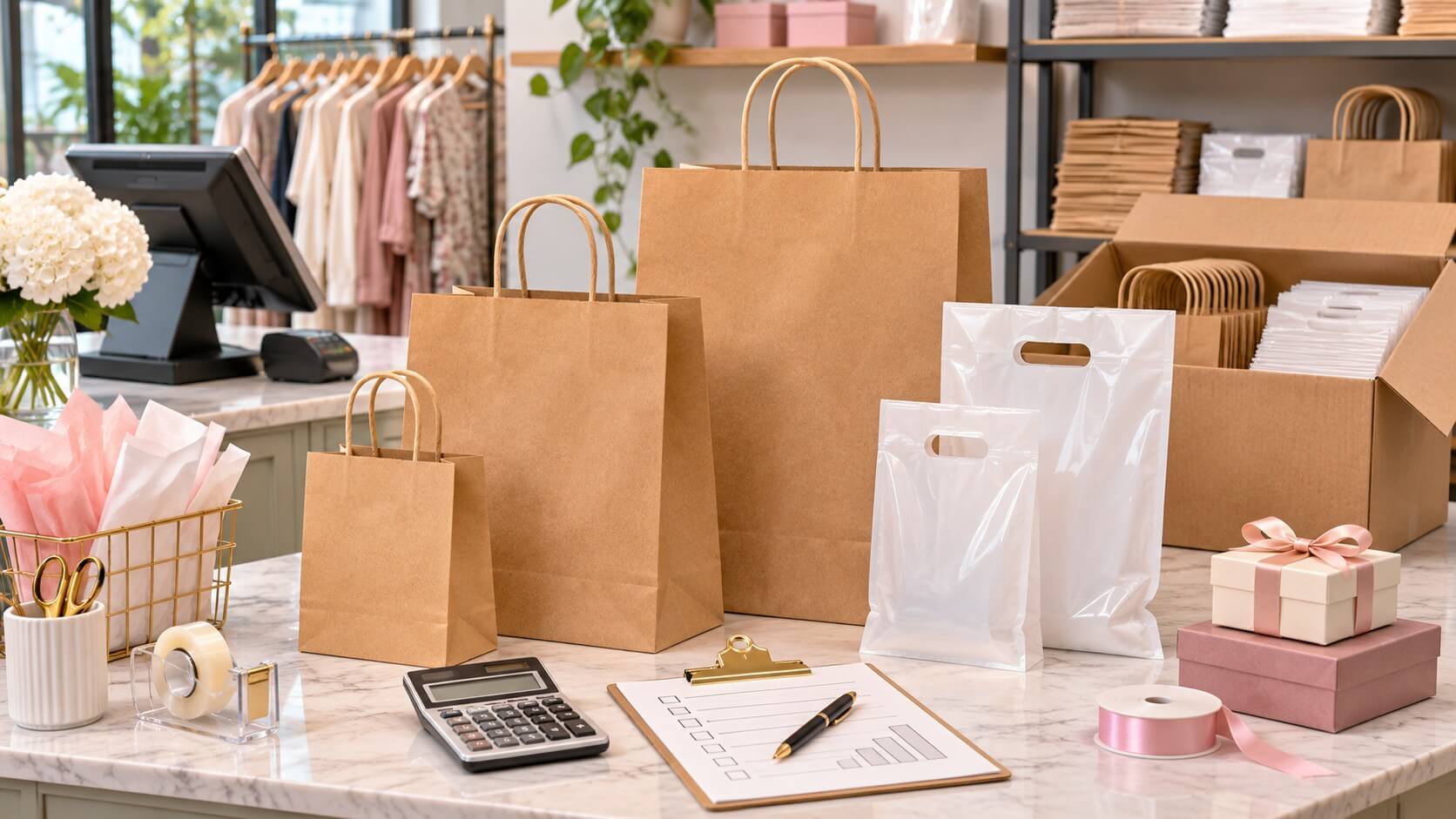
Most stores do not use one bag for every sale. A small purchase goes in a small bag, and a big purchase goes in a larger one. Rather than ordering your whole year in a single size, split your totals across the sizes you actually use.
A common breakdown for an apparel or gift store looks like this:
- Small bags: around 30 percent of sales (single small items, jewelry, accessories)
- Medium bags: around 50 percent of sales (the everyday workhorse)
- Large bags: around 20 percent of sales (multiple items, coats, bulky goods)
Adjust those percentages to match what you sell. A boutique that moves a lot of folded apparel will lean heavier on medium and large. A jewelry counter will lean small. If you are choosing between materials, our Kraft Paper Bags and Plastic Merchandise Bags categories both come in a range of sizes so you can match the bag to the purchase.
Add a Peak-Season Buffer
Your flat annual estimate assumes every week looks the same. It does not. Holidays, back-to-school, and local events can double or triple a normal week. If you sell seasonal or gift merchandise, plan for that.
A simple approach: take your annual estimate and add 10 to 20 percent as a buffer for busy periods and the occasional double-bagged order. It is far cheaper to have a little extra than to run out on Black Friday.
How Much Bag Stock Should You Keep on Hand?
Knowing your annual number is one thing. Knowing how much to store at once is another. You do not want a year of bags sitting in your backroom on day one.
For most independent stores, keeping one to three months of bag stock on hand is a sensible target. That gives you a cushion against shipping delays without turning your storage area into a warehouse.
Here is how to translate that into an order:
- Take your annual estimate and divide by 12 to get your monthly usage.
- Decide how many months of cushion you want (two is a safe middle ground).
- Multiply monthly usage by that cushion to set your reorder quantity.
A store using roughly 15,600 bags a year burns about 1,300 a month. A two-month cushion means keeping around 2,600 bags on hand and reordering when you drop below one month's worth.
One thing worth checking before you buy: cases come in different counts. Some of our bags ship in a case of 100, others in a case of 500 or 1,000. Always confirm the case quantity on the product page so you know how many cases equal your target stock level.
Do Not Forget the Support Supplies
Bags are the headline, but they rarely travel alone at the register. As you place your first bag order, it helps to round out the checkout station in one go.
A few items that pair naturally with bags:
- Gift Boxes and Apparel Boxes for customers who want their purchase presented nicely. You will find these in our gift packaging selection.
- Resealable Plastic Bags for loose or small items like jewelry and beads.
- Tissue Paper , Rubber Bands, and Packaging Supplies to keep the wrap station moving.
In my experience working with retailers, the ones who came back happiest were those who set up their whole checkout at once instead of ordering piecemeal every week. It saves you repeat shipping and the scramble of realizing you are out of something mid-shift..
A Quick Sanity Check Before You Buy
Before you finalize that first order, run through this short list:
- Did you base your count on an average day, not your best day?
- Did you split the total across the sizes you actually use?
- Did you add a buffer for busy seasons?
- Are you ordering one to three months of stock, not a full year at once?
- Did you check the case quantity so you know what you are really getting?
The point of all this is not to nail the number perfectly. It is to get close enough that you are not scrambling in month two or storing excess bags you will not touch until next fall. Start with a conservative first order, track how fast you actually go through bags in your opening weeks, and adjust your reorder from real data. After a month of sales, your own numbers will tell you more than any estimate, and you can fine-tune from there with confidence.
Written by Kris Boettigheimer
Purchasing Assistant
Kris brings over 32 years of retail industry experience and more than 20 years at Store Supply Warehouse to every article he writes for storesupply.com. Since joining SSW in 2005, Kris has worked across multiple departments , including six years in Sales/Customer Service, where he helped independent retailers and small business owners find the right store fixtures, retail displays, and merchandising supplies to improve their store layouts and drive sales. For the past 15+ years in SSW's Purchasing Department, he has collaborated with suppliers, tracked market trends, and sourced products across all three Store Supply divisions. Today, Kris channels that hands-on experience into content that helps retailers enhance store presentation, discover new display solutions, and make smarter product decisions.