The 7 Packaging Supplies Every Home-Based Seller Should Stock
When you run a business from your kitchen table or spare bedroom, your packaging does two jobs. It protects what you sell, and it tells the customer you take your work seriously. The trick is stocking the right items without filling a closet with supplies you rarely use.
My name is Kris Boettigheimer and I work in the Purchasing Department here at Store Supply Warehouse. Over the years I have talked with hundreds of small sellers who started their business at home. The ones who got packaging right early saved money and looked professional from their very first order. Below is the short list I point people to, along with how to decide what to buy first.
How to think about packaging before you buy
Most home sellers handle orders two ways: shipping to online buyers and handing products directly to people at markets, pop-ups, or local pickups. You need supplies for both situations, and a few items cover both at once.
Before you order a thing, answer three questions:
- What are you selling? Soft goods like apparel ship differently than fragile or loose items.
- How do most sales reach the customer? Mail, in person, or a mix.
- What should the unboxing feel like? Plain and functional, or branded and gift-like.
Your answers decide which of the seven items below you buy heavy and which you keep in smaller amounts.
1. Poly mailers for soft, non-fragile shipments
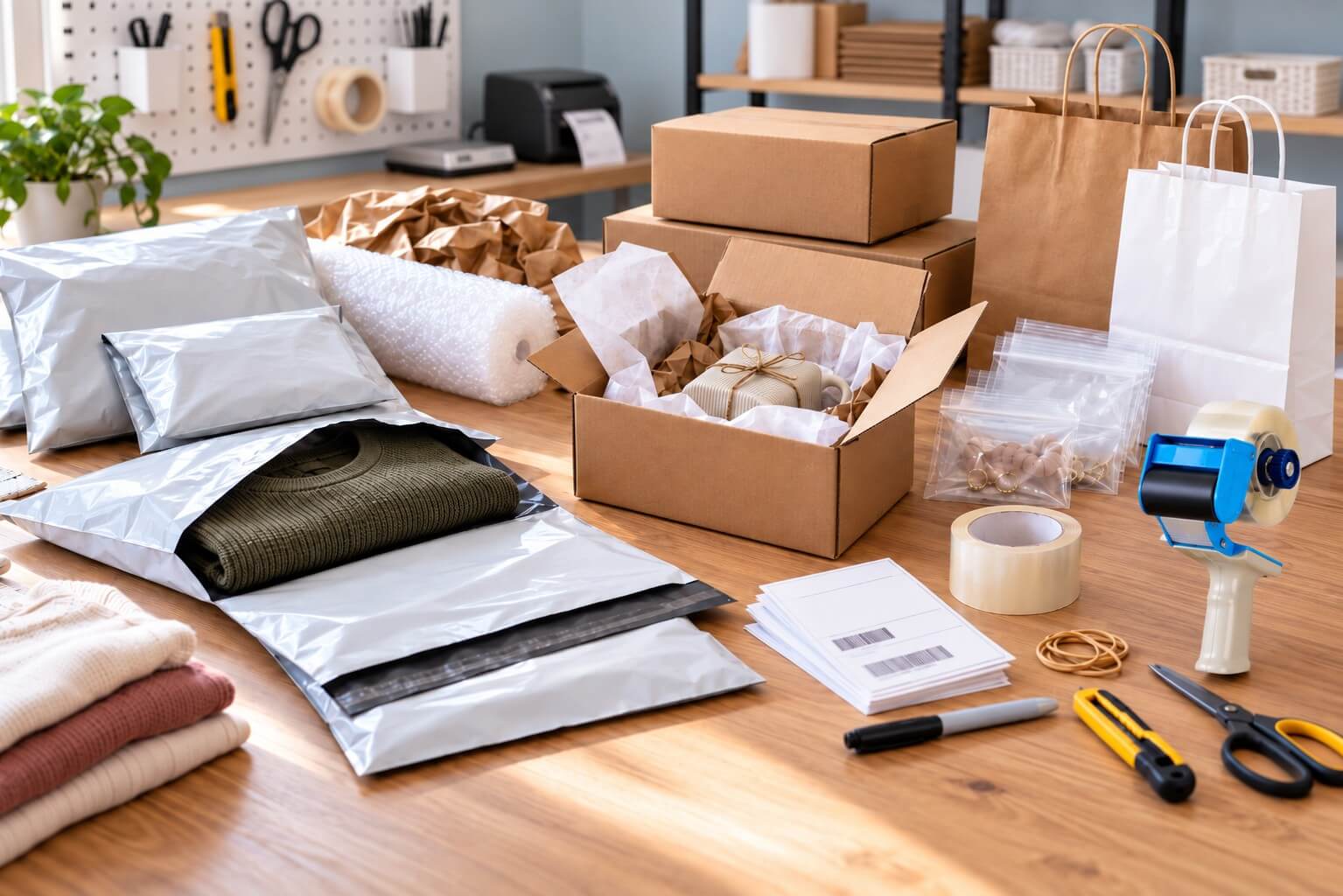
Poly Mailers are the workhorse of a home shipping station. They are lightweight, they resist moisture, and they keep shipping costs down because they add almost no weight to the package. For apparel, accessories, fabric goods, and other items that bend, a poly mailer is usually your cheapest reliable option.
In my experience, the most common mistake new sellers make here is only ordering one size. You end up stuffing a small item into a large mailer or forcing a bulky one into a snug pouch. Keep at least two sizes on hand so you are not paying for air or wrestling with a tight fit.
Poly mailers are not for fragile or sharp items. Those need a box.
2. Shipping boxes for anything that can crush or break
Rigid items, breakables, and anything you want to arrive looking crisp belong in a box. Our 12" x 12" x 6" Shipping Boxes work well for glass and ceramics or other similar pieces. Check the product page for exact dimensions so you order a size that matches what you ship most often.
You do not need a wall of box sizes on day one. Pick one or two sizes that fit your typical order, and add from there as you learn your patterns.
3. Protective fill so items arrive the way they left
Nothing undoes a nice package faster than a product rattling around loose inside. Protective fill keeps items from shifting and takes the shock out of rough handling.
Options range from Tissue Paper and Packing Paper to Bubble Wrap. For most home sellers, tissue paper does double duty: it wraps the product, fills empty space, and makes the unboxing feel considered. Keep it simple and buy what matches the items you actually ship.
4. Retail and merchandise bags for in-person handoffs
The moment you sell at a market or hand an order to a local pickup, you need a bag. A customer walking away with a bare product looks unfinished. A customer carrying a clean bag looks like they shopped at a real store.
You have two main directions here. Plastic low density merchandise bags are durable, have a glossy finish, and come in cases that last a long while. They are a practical choice when you move a lot of product and want a low cost per bag.
If you want a more upscale handoff, paper kraft shopping bags with handles feel sturdier and present well. Many sellers keep both: plastic for everyday volume and paper for larger or gift-type purchases.
Bags or mailers: how to choose
This question comes up constantly, so here is the simple version.
|
Situation |
Best choice |
|
Shipping soft goods by mail |
Poly mailer |
|
Shipping fragile or rigid items by mail |
Box with fill |
|
Handing a product to a customer in person |
Retail or merchandise bag |
|
Small loose items (jewelry, beads, parts) |
Resealable bag inside a mailer or box |
Mailers and bags are not interchangeable. A mailer is built to survive the mail stream. A retail bag is built for a short trip from your table to the customer's car. Buy for the job each one does.
5. Resealable bags for small and loose items
If you sell anything small or in pieces, you will want resealable clear plastic bags. They keep jewelry, beads, hardware, and small parts together so nothing escapes inside a larger package. They also protect items from dust and moisture.
I have watched more than one seller lose small components in the bottom of a shipping box because they skipped this step. A resealable bag costs pennies and prevents a refund and an apology. It is cheap insurance.
6. Tissue paper and a branded touch
Tissue is the easiest way to make an order feel intentional without spending much. Wrap the product, add a small thank you note, and the unboxing suddenly feels like a gift rather than a shipment. For in-person sales, a sheet of tissue in the bag does the same thing.
You do not need custom printing to start. A consistent color, a stamp, or a simple sticker ties your packaging together and makes your brand recognizable. Add the fancier touches once your orders are steady.
7. Tape, labels, and the small stuff that holds it all together
The last category is easy to forget until you are mid-order with nowhere to put a shipping label. Stock these before you need them:
- Packing Tape and a Carton Sealer you can work one-handed
- Shipping label sheets or thermal labels for your printer
- A marker for notes or addresses
- Scissors or a safe box cutter
- Rubber bands for bundling tissue, closing bags, or grouping small items
These items are inexpensive, but running out of any one of them stops your whole fulfillment process. Keep a backup of each so a busy week never catches you short.
Which items to buy in bulk first
You asked the question I hear most: where do I put my money on day one? Buy in bulk the items you use on every single order. For almost every home seller, that means the shipping container (poly mailer or box), the fill (tissue), and tape. Those get consumed fastest.
Buy retail and merchandise bags in bulk too, because case quantities bring the cost per bag way down and the bags do not expire. Hold off on buying every size and color until you know your order mix. It is easy to overbuy specialty sizes you only reach for once a month.
A good starting rule: stock about a month of the items you use on every order, and smaller amounts of anything situational. Once you have shipped for a few weeks, your own numbers will tell you exactly what to reorder and in what size. That real data beats any guess, including mine.
Start with these seven categories, match the sizes to what you actually sell, and you will be ready to fulfill orders and greet in-person customers without scrambling for the right bag or box.
Written by Kris Boettigheimer
Purchasing Assistant
Kris brings over 32 years of retail industry experience and more than 20 years at Store Supply Warehouse to every article he writes for storesupply.com. Since joining SSW in 2005, Kris has worked across multiple departments , including six years in Sales/Customer Service, where he helped independent retailers and small business owners find the right store fixtures, retail displays, and merchandising supplies to improve their store layouts and drive sales. For the past 15+ years in SSW's Purchasing Department, he has collaborated with suppliers, tracked market trends, and sourced products across all three Store Supply divisions. Today, Kris channels that hands-on experience into content that helps retailers enhance store presentation, discover new display solutions, and make smarter product decisions.